
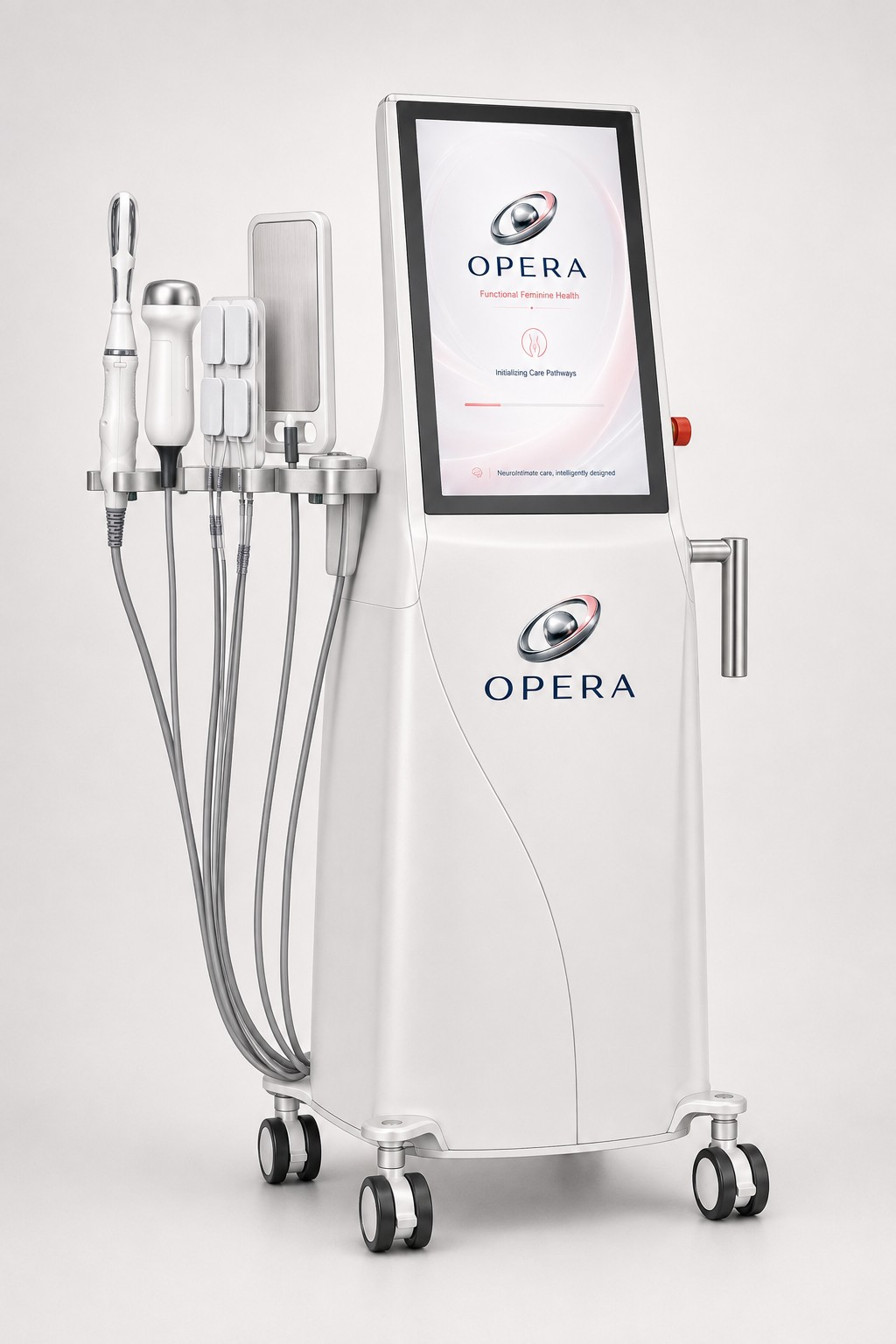

NeuroIntimate Feminine Health
Where vaginal health
becomes NeuroFunctional.
Opera evaluates the introital neurointimate interface — internal vaginal tissue, introital transition zone, vulvar/labial field, scar-sensitive environments, sensory pathways, and anterior bladder-pelvic coordination. Neural-first. Phenotype-driven.
Request a Clinical Consultation
An Opera Feminine Health Specialist will contact you within 24 hours.
Platform
NeuroIntimate
Care System
Approach
Phenotype-Driven
Protocols
50–84%
Of postmenopausal women report genitourinary symptoms — fewer than 25% receive treatment (NAMS 2020)
77%
Of postpartum women report pelvic symptoms at 3 months, including tissue, sensory, and bladder-pelvic concerns (Gartland et al.)
40%
Of women report symptoms of sexual pain or discomfort — the majority go unaddressed in routine clinical encounters (ISSWSH)
1 in 3
Women will experience significant vulvovaginal or introital symptoms during their lifetime (ACOG)
The Opera Framework
The layer
behind the complaint.
Opera maps the introital neurointimate interface — the tissue layer, introital transition zone, vulvar/labial field, scar-sensitive environment, and sensory pathways that influence comfort, tolerance, bladder-pelvic coordination, and recovery.
Conventional care addresses the symptom. Opera addresses the neurointimate interface — the tissue, sensory, and neural architecture that determines why the symptom exists and what it will take to resolve it.
Internal Vaginal Tissue
Mucosa, lamina propria, connective tissue, hydration, elasticity, pliability, collagen support and tissue tolerance.
Distal Introital Transition Zone
Vaginal opening, vestibular tissue, perineal body and external vulvar/labial interface where entry sensitivity and friction discomfort often concentrate.
External Vulvar/Labial Field
Labia majora, labia minora, adjacent mucosal maturation, variable vulvar keratinization and sensory density.
Scar-Sensitive Tissue Environment
Healed laceration, episiotomy, perineal repair, C-section or prior trauma where tethering, tenderness or altered collagen mobility may persist.
Sensory Tolerance & Guarding
Low tolerance to touch, pressure, heat, friction or insertion; neural volatility and protective tightening before or during contact.
Anterior/Bladder-Pelvic Interface
Anterior vaginal wall, urethral-support context, urgency/frequency, internal awareness and sacral-pelvic coordination when the issue is not purely motor weakness.

Postpartum Recovery
Recovery doesn't end
at the six-week visit.
77% of postpartum women report pelvic symptoms at three months — tissue recovery, scar sensitivity, sensory guarding, and bladder-pelvic coordination issues that persist well beyond standard discharge. Opera routes by healing stage and dominant driver, not by a fixed postpartum protocol.
Tissue Recovery
By healing stage
Scar Sensitivity
Episiotomy · Laceration · C-section
Neural Guarding
Sensory tolerance routing
Clinical Intelligence
What makes Opera
remarkably distinct.
Opera combines intelligent preset protocols with clinician-guided sequencing — giving specialists the structure of a validated pathway and the flexibility to route by phenotype.
NeuroSynchronization
Afferent and efferent. Simultaneously.
Opera takes a neural-first approach — addressing both the efferent motor pathway and the afferent sensory pathway within the same sequenced protocol. NeuroSynchronization modulates the pudendal nerve field, vulvar sensory density, and sacral-pelvic coordination in a way that tissue energy alone cannot achieve.
Phenotype-Driven Sequencing
Route by dominant driver. Not by preset category.
NeuroSynchronization, NeuroSacral/NeuroField, and NeuroLoop sequencing allow the clinician to route by the patient's dominant driver — tissue pliability, sensory volatility, neural guarding, scar sensitivity, or anterior bladder-pelvic coordination — rather than applying a fixed protocol to a named complaint.
Vaginal — Not Pelvic Floor
The structures PFM cannot reach.
Opera addresses internal vaginal tissue, the introital transition zone, the vulvar/labial field, the anterior vaginal wall, and urethral support context. These are anatomically distinct from the pelvic floor musculature. Opera does not compete on PFM proximity — it addresses the neurointimate interface that external PFM engagement cannot influence.
Intelligent Presets
Validated pathways. Ready at the console.
Opera's preset protocols are built on phenotype-validated sequencing — the clinician selects the dominant driver and the system initializes the appropriate energy modality, applicator sequence, and neural pathway protocol. Consistent. Reproducible. Evidence-grounded.
Clinician-Guided Sequencing
Full clinical control when the presentation demands it.
For complex or multi-driver presentations — postpartum patients with concurrent tissue recovery, scar sensitivity, guarding, and bladder symptoms — Opera allows the clinician to route by healing stage and dominant driver rather than reducing care to a single protocol.

Clinical Indications
The most in-demand patient presentations.
Addressed in one system.
Each indication is addressed through phenotype-driven sequencing — routing by dominant driver across tissue, sensory, neural, and structural dimensions.
01
Vaginal Tissue Laxity
Introital laxity · Vaginal wall tone · Connective tissue support · Post-delivery tissue change
02
Genitourinary Syndrome of Menopause (GSM)
Mucosal atrophy · Vaginal dryness · Dyspareunia · Tissue fragility · Introital narrowing
03
Vulvovaginal Atrophy
Epithelial thinning · Reduced lubrication · Keratinization changes · Labial tissue loss
04
Dyspareunia & Entry Discomfort
Introital friction · Vestibular sensitivity · Tissue tolerance · Insertion discomfort
05
Sensory Tolerance & Neural Guarding
Touch/pressure hypersensitivity · Neural volatility · Protective tightening · Friction intolerance
06
Vulvodynia & Vestibulodynia
Chronic vulvar pain · Vestibular allodynia · Sensory field dysregulation · Contact sensitivity
07
Scar Tissue & Perineal Repair
Episiotomy scar · Laceration repair · C-section adhesion · Tethering · Altered collagen mobility
08
Postpartum Neurointimate Recovery
Tissue recovery by healing stage · Scar sensitivity · Guarding · Return-to-function routing
09
Bladder-Pelvic Coordination
Urgency/frequency · Anterior vaginal wall · Urethral support context · Sacral-pelvic coordination
10
Stress Urinary Incontinence (SUI)
Urethral support · Anterior vaginal wall integrity · Bladder neck · Effort-related leakage
11
Hormonal Transition — Perimenopause
Estrogen decline · Tissue quality change · Mucosal hydration · Sensory threshold shift
12
Hormonal Transition — Postmenopause
Advanced atrophic change · Introital stenosis · Collagen loss · Chronic dryness
13
Vaginismus & Pelvic Guarding
Involuntary protective tightening · Insertion intolerance · Neural sensitization · Guarding cycle
14
Labial & Vulvar Tissue Support
Labia majora/minora volume · Mucosal maturation · Keratinization · Sensory density
15
Oncology-Related Vaginal Changes
Radiation-induced atrophy · Chemotherapy tissue effects · Surgical change · Mucosal integrity
16
Hypoactive Sexual Desire — Tissue Component
Tissue-mediated avoidance · Anticipatory guarding · Sensory threshold · Introital tolerance
17
Arousal & Sensory Pathway Support
Pudendal nerve field · Clitoral sensory density · Vulvar sensory modulation · NeuroSynchronization
18
Lichen Sclerosus — Adjunct Support
Tissue pliability · Scar remodeling · Sensory field · Adjunct to primary dermatologic management

Hormonal Transition
Perimenopause.
Menopause.
The tissue tells the story.
50–84% of postmenopausal women report genitourinary symptoms. Fewer than 25% receive treatment. Opera addresses the full spectrum of hormonal tissue change — mucosal atrophy, introital narrowing, labial tissue loss, sensory threshold shift — through phenotype-driven sequencing calibrated to the stage of transition.
Perimenopause
Estrogen decline · Tissue quality · Sensory shift
Postmenopause
Atrophic change · Introital stenosis · Dryness
GSM
Mucosal atrophy · Dyspareunia · Fragility
Vulvovaginal Atrophy
Epithelial thinning · Labial tissue loss
Applicator System
Each applicator.
A distinct clinical function.
Opera's applicator architecture is designed around the six neurointimate fields — not around a single energy modality. Each instrument is purpose-built for its anatomical target and sequencing role.
External Vulvar/Labial Field
NeuroHalo
Addresses the external vulvar/labial field — labia majora, labia minora, adjacent mucosal maturation, variable keratinization, and sensory density. Delivers targeted energy to the distal introital transition zone and perineal body.
Sacral-Pelvic Neural Pathway
NeuroSacral
Targets the sacral-pelvic neural pathway — supporting NeuroSynchronization sequencing, anterior bladder-pelvic coordination, and the efferent/afferent interface when sensory guarding or urgency/frequency is the dominant driver.
Internal Vaginal Tissue
Internal Vaginal Applicator
Delivers multi-modality energy to internal vaginal tissue — mucosa, lamina propria, connective tissue, hydration, elasticity, pliability, and collagen support. The primary instrument for tissue-layer phenotype presentations.
Neural Field Sequencing
NeuroField Pad Array
Supports NeuroField and NeuroLoop sequencing protocols — used when the clinical presentation requires distributed neural field modulation across the pelvic-sacral region rather than focal tissue energy delivery.

Quality of Life
When the tissue heals,
life opens back up.
The goal of NeuroIntimate care is not clinical resolution alone — it is the restoration of comfort, confidence, and daily function. Women who complete a phenotype-driven Opera protocol report returning to physical activity, intimacy, and quality of life that had been diminished for months or years.
Clinical Specializations
Built for the specialists who manage these pathways.
Partner with Opera
Evaluate the neurointimate interface in your practice.
Opera is available exclusively to licensed women's health clinicians. Our clinical team will walk you through the system architecture, phenotype-driven sequencing protocols, and practice integration — tailored to your specialty and patient population.
Specialty-specific neurointimate protocol walkthrough
Live system and sequencing demonstration
Phenotyping framework and clinical decision support review
Practice economics and integration pathway
Full clinical evidence dossier — 140+ peer-reviewed references
Request Your Clinical Consultation
For licensed healthcare professionals only. Response within 24 hours.